With more than 250 years of combined industry experience, ACT Research is the leader in market data, industry analysis, and forecasting for the commercial vehicle and transportation markets.
1. Economy - The US economy continues to reflect surprising resilience, but the balance of risks could become less favorable. While consumers continue to face affordability pressures from slowing real disposable income growth, high prices, elevated borrowing costs, and a diminished savings buffer, business investment has become a key source of economic strength. Robust spending on AI infrastructure, data centers, manufacturing, and energy projects continues to support capital expenditures, leaving the economy increasingly reliant on investment-led growth to offset softer household demand.
2. Medium Duty - June’s preliminary net orders totaled 17,200 units. With orders trending higher, OEMs are responding by increasing build, but sales continue to lag.
3. Class 8 - After over a year spent mum regarding rules for low-NOx regulations, the EPA finally released its final proposal for 2027 regulations, just in time for OEMs and carriers seeking pricing clarity ahead of 2027 orderboards opening.
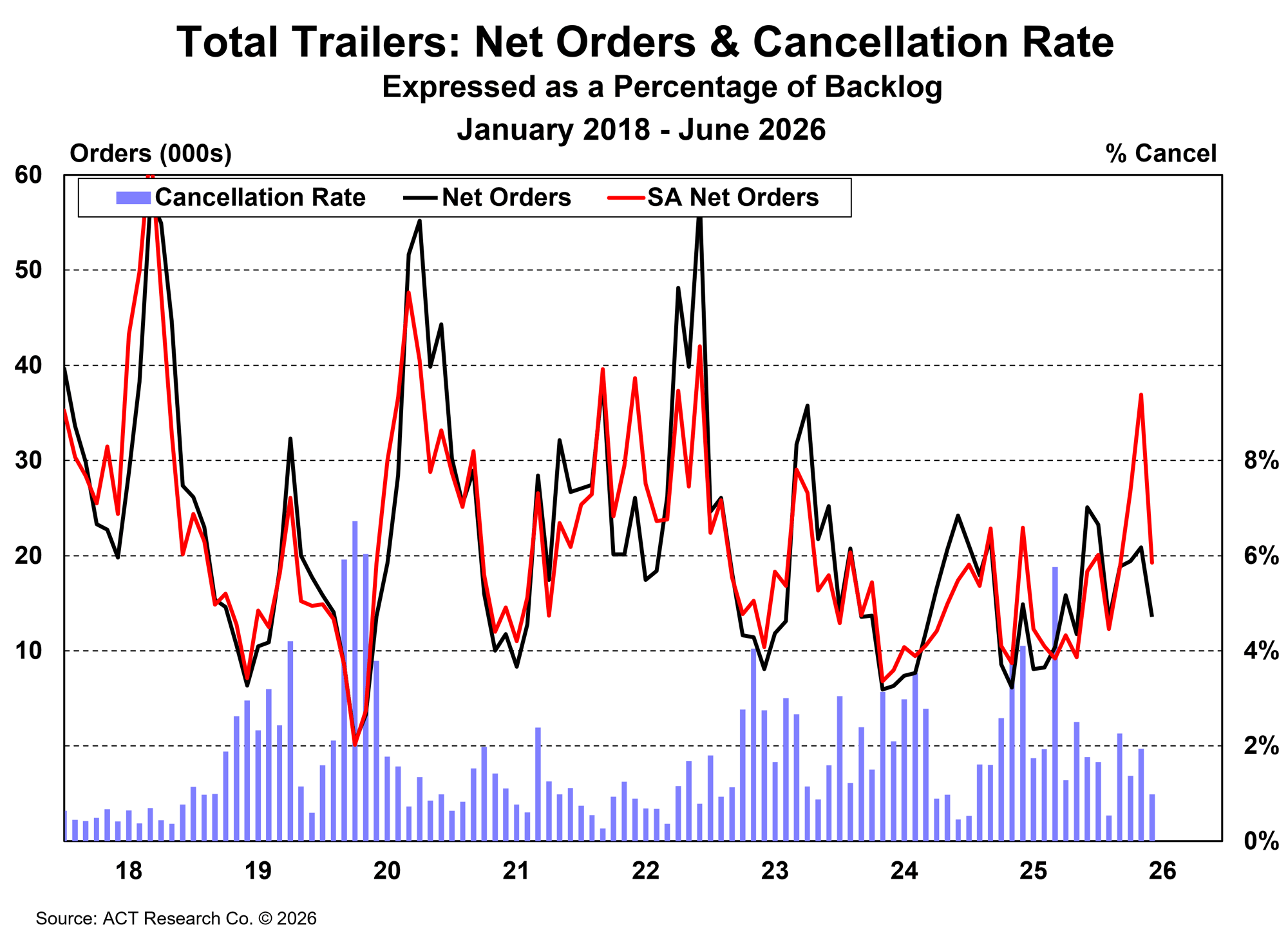
4. Trailer - Counter to cyclical expectations, net order intake in May increased from April, albeit by just 7.6%, logging 20.9k orders. Although it may seem like it’s been a while, one only needs to go back to this past January to find another month of 20k+ net order intake. Compared to May 2025, net orders vaulted more than 140% over the lackluster intake of 6.1k last year. SA trailer orders were 36.9k units compared to a 26.8k SA rate in April.
5. Used Truck - May same dealer used Class 8 retail truck sales wilted m/m (-13%), but made progress longer term. The drop was directionally consistent with, but greater than, the expected 3% seasonal slide. May is the third weakest sales month of the year, running 5% below average. The auction and wholesale markets were mixed in May.


1. The shipments component of the Cass Freight Index fell 4.1% y/y and 3.1% m/m in June.
2. Aggregate DAT contract rates rose 6¢ m/m in June to $2.26 per mile, up 12% y/y, and up 5¢ m/m SA.
3. DAT US dry van TL spot rates, net fuel, rose 45% y/y in June, accelerating from 33% in May.
4. Class 8 tractor orders rose to about 20,000 units in June from 15,679 in May.
5. US dealers sold 11,509 new Class 8 tractors in May, down 10% y/y.


Final North American Class 8 net orders totaled 31,751 units in June, more than tripling y/y and rising 25% m/m on a seasonally adjusted basis.
“Broad tariff uncertainty last year certainly contributed to the easy y/y comp, but more importantly, demand for new equipment continues to be buoyed by the sustained and extraordinary momentum of freight rates over the past four months,” according to Carter Vieth, Research Analyst at ACT Research. “With freight conditions rapidly improving, tractor orders nearly quadrupled to 22,041 units in June. Vocational Class 8 orders totaled 9,710 units (12.2k SA), increasing 150% y/y. Like the tractor market, easy comps due to tariffs and poor EPA communication this time last year partly explain the y/y rebound, but with AI hyperscalers spending ~$15–$20 billion per week on infrastructure and flatbed spot rates at record highs, demand is certainly not lacking.”


June same dealer used Class 8 retail truck sales bounced back from May’s weakness by 9.6%, extending their long-term gain by 4.0% y/y.
“The increase was directionally consistent with, but greater than, the expected 2% seasonal bump. June is the fifth weakest sales month of the year, running 3% below average,” said Steve Tam, Vice President at ACT Research. He continued, “The auction and wholesale markets were both softer in June. Auction volumes slumped 22% m/m, unusual for the last month of the quarter. Wholesale dealer activity trickled 4.8% lower m/m. Combined, June’s total market same dealer sales volumes were down 5.1% m/m.”


With equipment order intake improving, freight rates increasing, policy impacts becoming clearer, and despite concerns remaining, optimism is on the rise.
“After delivering counter to cyclical expectations results the past three months, net order intake in June slowed in seasonal fashion. Net US trailer orders in June were 13,500 units, down about 7,300 units from May, a 35% month-to-month decrease. Compared to June 2025, this year’s intake was 1,300 units lower, nearly a 9% decrease,” said Jennifer McNealy, Director–CV Market Research & Publications at ACT Research. “June’s cancellation rate of 1.0%, as a percentage of backlog, dropped from ‘elevated’ territory, and now sits at the top of the target range. Still, it is an improvement from May’s 1.9% cancellation rate. Like last month, high cancellations were reported in most segments, meaning the situation was broad-based.”